
learn
600state
“Neither slavery nor involuntary servitude, except as a punishment for crime whereof the party shall have been duly convicted, shall exist within the United States, or any place subject to their…#blackhistory: On February 1, 1865, Abraham Lincoln signed the 13th Amendment to the U.S. Constitution
share


Abraham Lincoln, three-quarter length portrait, seated and holding his spectacles and a pencil, February 5, 1865. Alexander Gardner, 1821-1882, photographer; <a href="https://www.loc.gov/pictures/item/98504569/">Library of Congress</a>
“Neither slavery nor involuntary servitude, except as a punishment for crime whereof the party shall have been duly convicted, shall exist within the United States, or any place subject to their jurisdiction.” - The 13th Amendment to the U.S. Constitution
The 13th Amendment to the U.S. Constitution is first in the trio of so-called “Reconstruction Amendments” that, along with the 14th and 15th Amendments, completed the legal framework of abolition by ending slavery (13th), defining citizenship (14th), establishing due process and equal protection (14th), and establishing the right to vote for African American men (15th).
The 13th grew from Abraham Lincoln’s Emancipation Proclamation of January 1, 1863, which proclaimed that slaves in the US states then in rebellion were free. Epochal as it was, the Proclamation was a wartime measure, issued under Lincoln’s authority as commander in chief and not an act of Congress.
The first of what would be many such Congressional bills to take up the formal abolition of slavery was introduced on December 14, 1863, by Representative James Mitchell Ashley of Ohio, with a final version passing the Senate on April 8, 1864. The proposed amendment to the Constitution was stymied in the House until January 31, 1865, after which it was sent to the states for ratification.
The President of the United States has no formal role in the amendment process under the Constitution. All the same, the January 31st resolution was sent to Lincoln and he added his name to it (along with the word “Approved”) on February 1, 1865. This small gesture by Lincoln, like many of his actions, was cause for legislative consternation. On February 7, 1865, Congress would pass a resolution restating that the President had no role in the amendment process and that his signature was unnecessary. This makes the 13th the only ratified amendment signed by a President.
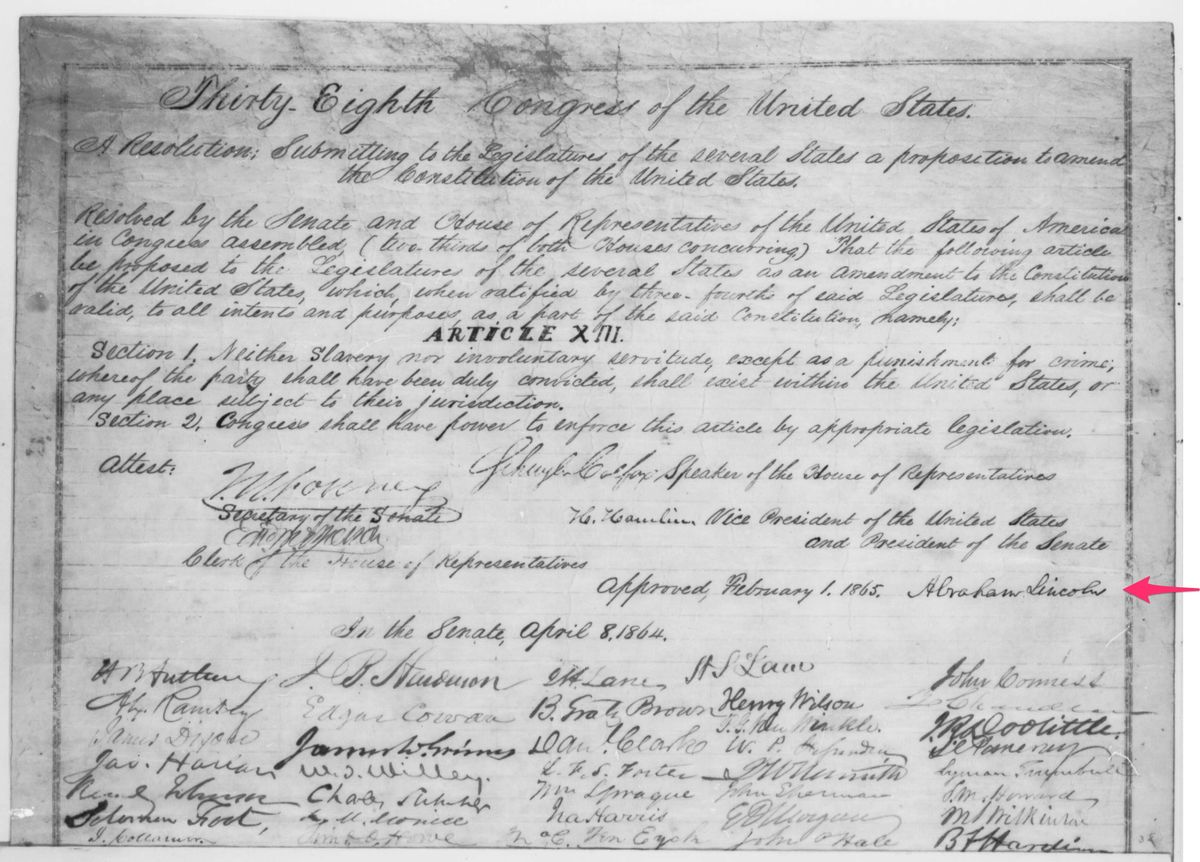
The date of Lincoln’s “unnecessary” signature is also the date the 13th Amendment was sent to the states for ratification. By the end of February 1865, eighteen states had ratified it, nine short of the two-thirds needed under Article V of the Constitution. The question of who could ratify and under what circumstances was not a small one. The new state legislatures in those parts of the Confederacy that had fallen by February of 1865 were either nonexistent or in disarray. Lee would not surrender until April 9, 1865, Lincoln would be assassinated on April 14th and the final shots of the Civil War were yet to be fired in June. Full ratification not would occur until December 6, 1865, when the ex-Confederate state of Georgia became the needed 27th state, with final certification coming on December 18, 1865.
And what of the remaining nine states which could have ratified the 13th Amendment? Our own state of California would ratify on December 19, 1865:
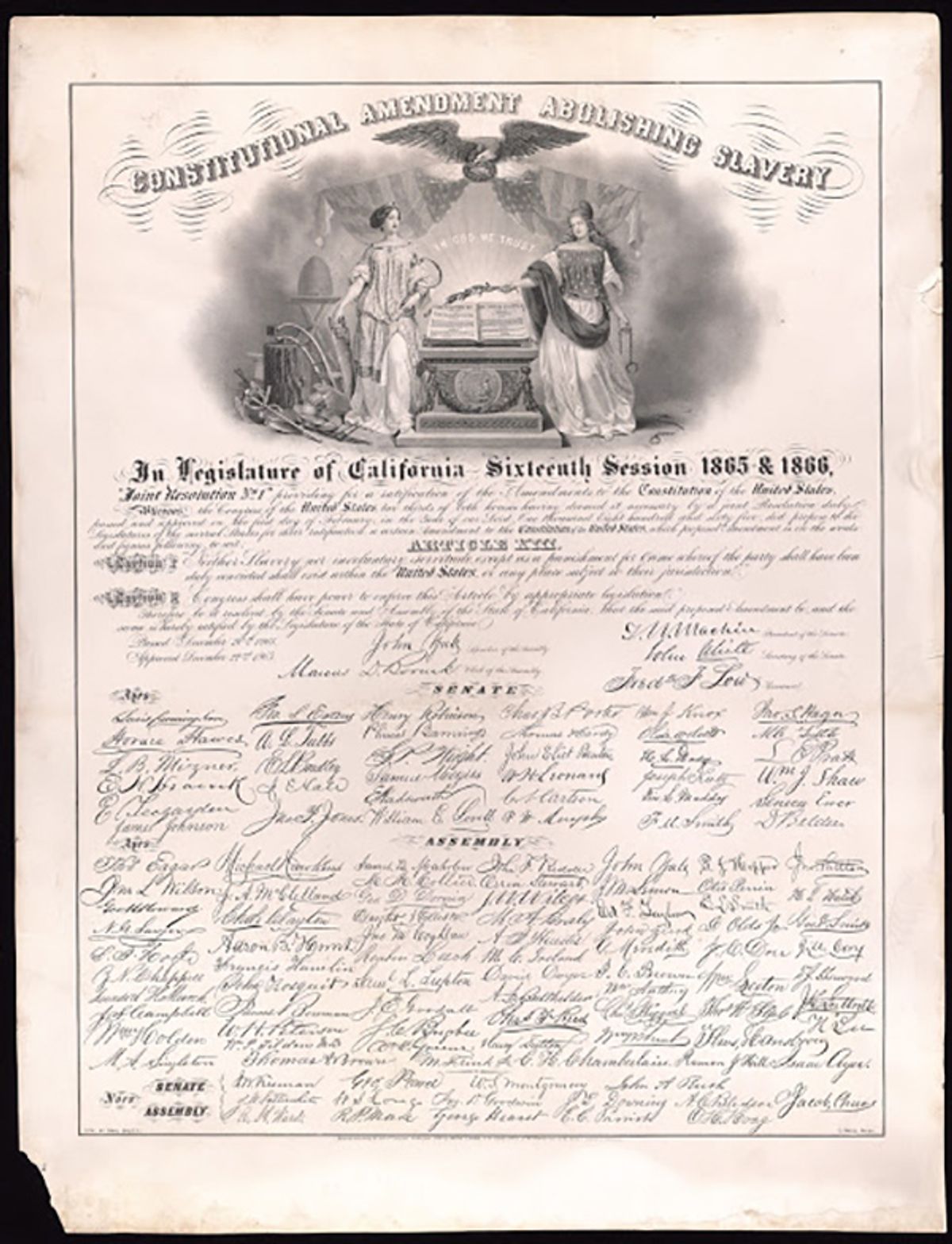
Oregon, Florida, Iowa, and New Jersey would also ratify within a few months, whereas Texas would not get to it until 1870. The Delaware legislature did not formally abolish slavery until 1901, Kentucky’s not until 1976. The last state to formally abolish slavery was Mississippi, where the secretary of state did not certify the legislature’s ratification of the 13th Amendment until February 7, 2013.
The larger question of black freedom in America remains similarly unsettled for many, the 13th Amendment’s allowance of slavery and involuntary servitude “as a punishment for crime” the foundation on which an entire edifice of mass incarceration has been built. As the legal scholar Michelle Alexander suggests in The New Jim Crow: Mass Incarceration in the Age of Colorblindness, “we have not ended racial caste in America; we have merely redesigned it.”
Ava DuVernay’s Oscar-nominated documentary 13TH took up this same theme in 2016:
Related Exhibitions
To learn more about the history of slavery in California, visit our exhibition California Bound: Slavery on the New Frontier, 1848–1865 on view until April 28, 2019.
Related Dates
- (link: https://caamuseum.org/learn/600state/blackhistory-on-january-10-1867-congress-passed-the-territorial-suffrage-act-which-allowed-african-american-men-in-the-western-territories-to-vote text: #blackhistory: On January 10, 1867, Congress passed the Territorial Suffrage Act which allowed African American men in the western territories to vote
popup: no)
- #blackhistory: On February 26, 1869, Congress sent the 15th Amendment to the U.S. Constitution to the states for ratification
- #blackhistory: On June 19, 1865, Union General Gordon Granger declares that Texas' enslaved people are free, a day they and their descendants would commemorate as Juneteenth
- #blackhistory: On September 15, 1829, Afro-Mestizo Mexican President Vicente Ramon Guerrero issued the Guerrero Decree, prohibiting slavery in most of Mexico