learn
600state
“The people of Texas are informed that, in accordance with a proclamation from the Executive of the United States, all slaves are free. This involves an absolute equality of personal rights and…#blackhistory: On June 19, 1865, Union General Gordon Granger declares that Texas’ enslaved people are free, a day they and their descendants would commemorate as Juneteenth
share


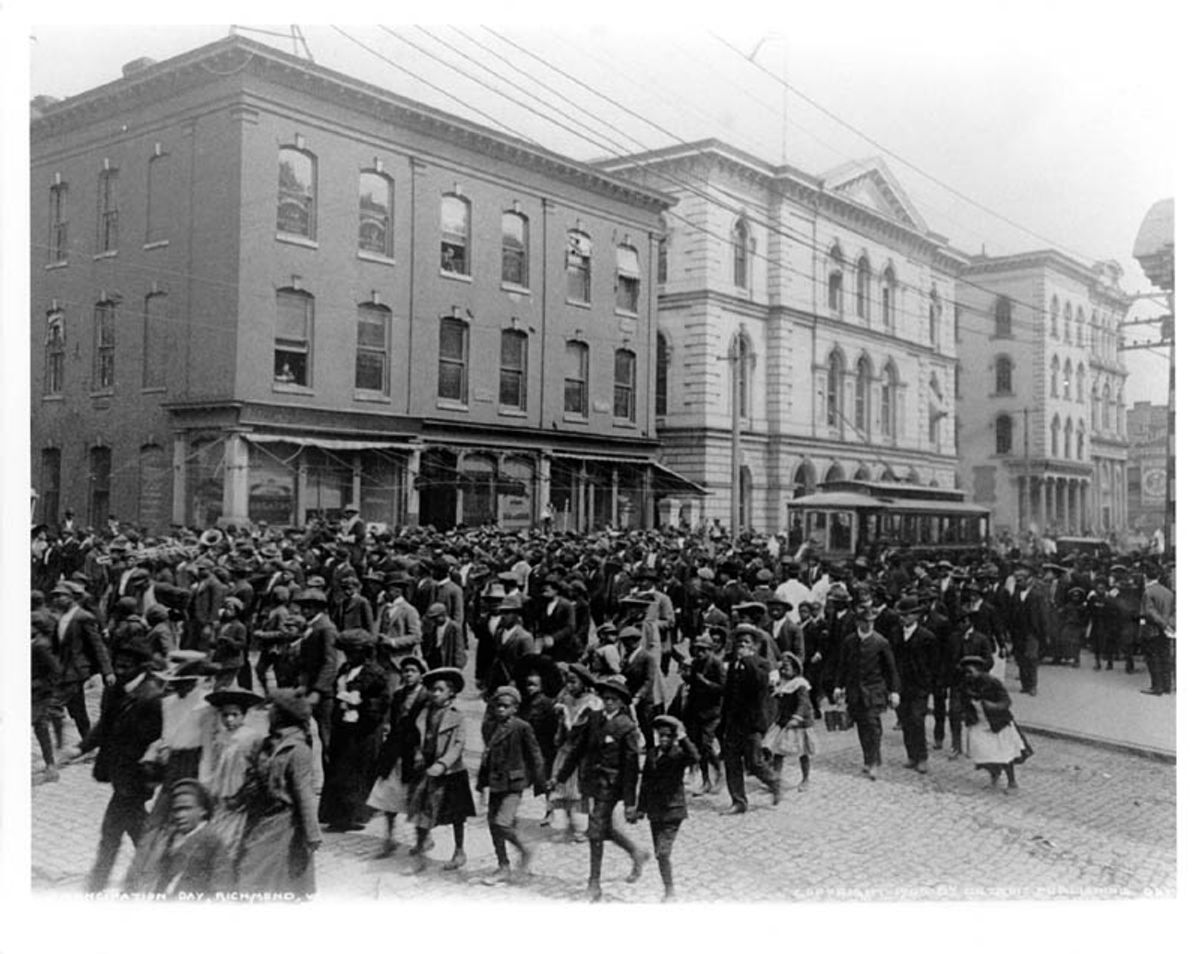
Mrs. Charles Stephenson (Grace Murray). Emancipation Day Celebration, June 19, 1900. University of North Texas Libraries, The Portal to Texas History. Crediting Austin History Center, Austin Public Library
“The people of Texas are informed that, in accordance with a proclamation from the Executive of the United States, all slaves are free. This involves an absolute equality of personal rights and rights of property between former masters and slaves, and the connection heretofore existing between them becomes that between employer and hired labor. The freedmen are advised to remain quietly at their present homes and work for wages. They are informed that they will not be allowed to collect at military posts and that they will not be supported in idleness either there or elsewhere.” —General Orders, Number 3; Headquarters District of Texas, Galveston, June 19, 1865
Science-fiction writer William Gibson has famously argued that “the future is already here, it’s just not very evenly distributed,” and the same could be said of Black freedom. The first Juneteenth—also known as Freedom Day or Emancipation Day—is a case in point. What is now America’s preeminent celebration of emancipation was inaugurated by a general order read from the balcony of a villa in Galveston by Union General Gordon Granger on June 19, 1865. The bulletin was news, but it was also already a statement of fact for most African Americans outside of Texas.
By that June afternoon, the Emancipation Proclamation had been in effect for two-and-a-half years, while the ink on Robert E. Lee’s surrender at Appomattox had been dry for three months. The Confederates west of the Mississippi in the Army of the Trans-Mississippi had won the last battle of the Civil War at Palmito Ranch on May 12, 1865, only to surrender two weeks later.
All the same, 250,000 people were still living in bondage in Texas, over half recent arrivals brought west in what Henry Louis Gates, Jr. has described as “a hurried re-enactment of the original Middle Passage,” as slave owners in Mississippi, Louisiana, and further east migrated to Texas after the capture of New Orleans in 1862 “to escape the Union Army’s reach.”
In addition to the slow speed of news and unsettled conditions, the spread of freedom to Texas had been hampered by a peculiar legal limbo. The Emancipation Proclamation had specifically declared that enslaved persons in states in rebellion and not in Union hands were free, but this left out those in border states not in rebellion—Kentucky, Maryland, Delaware, and Missouri—and in remote territories to the west like Texas. The announcement made by General Granger on June 19 settled the matter and, in doing so, set off a spontaneous celebration that has persisted to this day.
Perhaps because of its geographically specific origins, Juneteenth is often conflated with other important historical events on the road to emancipation. Lincoln’s proclamation was issued on September 22, 1862, while it actually went into effect the following January 1. The 13th Amendment abolishing slavery was ratified on December 6, 1865. As Gates notes, “Each of these anniversaries has its celebrants today.”
The first formal Juneteenth in Texas took place a year after the order in 1866, with Galveston’s formerly enslaved organizing an official marking of the holiday. As with much in Black life, Juneteenth’s fate was uncertain for many years—even in its birth state of Texas. Segregation meant that African Americans were barred from using public parks to celebrate—spaces such as Houston’s Emancipation Park and Emancipation Park in Austin were born explicitly to celebrate Juneteenth—while the lack of official recognition in the form of a state or federal holiday meant observing the date could involve losing a day’s pay or even a job. It wasn’t until 1980 that Texas became the first state to mark Juneteenth as a state holiday, albeit in the “skeleton crew” sense of state holiday, with offices open but staffed at lowered levels.
The present scramble by workplaces to somehow address the global, anti-racist ferment of May and June, as well as the initial decision by the Trump 2020 campaign to hold its first post-COVID-19 campaign rally on June 19—near the site of the 1921 Tulsa Massacre no less—has thrust the holiday back in the headlines this year.
In an interview with the Wall Street Journal, Donald Trump took credit for making Juneteenth “very famous.” “Nobody had ever heard of it,” Trump told the paper, which would of course come as a surprise to those who have marked the holiday for 155 years.
Today, 47 states, the District of Columbia, and hundreds of municipalities mark June 19 as either an official or ceremonial holiday, while millions take time via picnics, cookouts, and all manner of community celebrations to mark the day every African American was finally declared free.