
learn
600state
Racist attacks on Black lives and livelihoods have been a constant across American history; what wanes and waxes are their scales. On that score, the horrific events in Tulsa, Oklahoma over two days…#blackhistory: On May 31, 1921, the Tulsa Race Riot erupts in Tulsa, Oklahoma. Hundreds of African Americans are killed, and the thriving black neighborhood of Greenwood is razed
share


Smoke billowing over Tulsa, Oklahoma during 1921 race riots. Alvin C. Krupnick Co., photographer; <a href="https://www.loc.gov/pictures/item/95517018/">Library of Congress</a>
Racist attacks on Black lives and livelihoods have been a constant across American history; what wanes and waxes are their scales. On that score, the horrific events in Tulsa, Oklahoma over two days in 1921 - May 31 to June 1 - stand out against an already bloody backdrop.
On those two days, thousands of whites marauded through Tulsa's Greenwood district, then known as America's "Black Wall Street. Home to the early 20th Century's highest concentration of black businesses and wealth, Greenwood's main thoroughfare, Greenwood Avenue, was a case study in black self-sufficiency. Its red brick buildings housed banks, law and medical offices, real estate agencies, shipping companies, grocery stores, and manufacturers--fertile economic ground in which a thriving Black middle class took root.
The full toll of the attack on that ground in 1921 remains stubbornly hard to pin down.
The contemporaneous tally by the Oklahoma Bureau of Vital Statistics counted 36 dead, 21 of them white, but when a 2001 commission took a long overdue look back at the Riot, it found that somewhere between 100 and 300 African Americans had lost their lives. We do know that 800 were treated at hospitals, most of them black, and more than 6000 residents of Greenwood, which is to say, most of Greenwood, were arrested by Oklahoma National Guardsmen and detained for days.
Greenwood itself - over 35 blocks - would be burned to the ground, whites even taking to the air in privately owned planes flown from nearby Curtiss-Southwest Field to shoot at their black neighbors and drop jury-rigged incendiaries on Black homes and businesses. 10,000 Greenwood residents would become homeless, their material losses estimated at over $2.25 million or $32 million in 2019 terms. It would be 10 years before the survivors would rebuild, this in the face of opposition by Tulsa's city fathers who rezoned the area for the explicit purpose of thwarting its rebirth. But despite a hard-fought reconstruction, Greenwood never quite regained its footing, and an already depleted community would be further depleted by desegregation.
Over what, you might ask? A faulty elevator and a false allegation. A stubborn belief in the value in black life and the persistent belief in its worthlessness. On May 30, 1921, a black 19-year-old named Dick Rowland entered an elevator on the third floor of Tulsa's Drexel Building, which was being operated by a 17-year-old white woman named Sarah Page. That particular elevator was known not open level to the third floor, and Tulsa police would later find that Rowland tripped when he entered it and accidentally fell forward onto Page. She screamed at the contact and police were called. By the time Rowland was taken in for questioning on May 31, a seconds-long encounter had mutated into a lurid tale of physical and sexual assault.
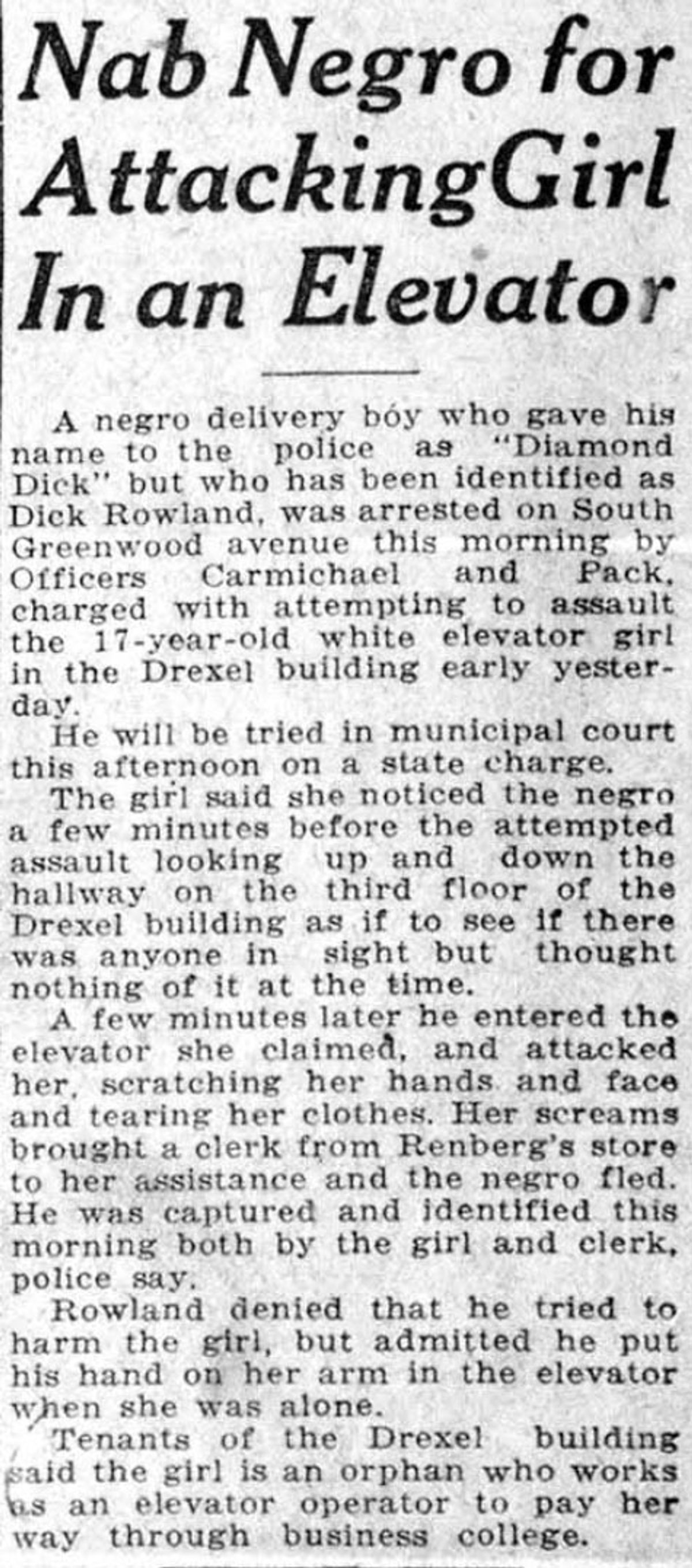
A white mob gathered at the courthouse where Rowland was being held to mete out their notion of justice, while a group of armed black men from Greenwood arrived to guarantee their understanding of the same. Shots were exchanged. Ten whites and two blacks would fall first, casualties of what the sensationalistic Tulsa press termed a "Negro uprising. followed by one of America's most prosperous black communities.