
learn
600state
“Section 1. The right of citizens of the United States to vote shall not be denied or abridged by the United States or by any State on account of race, color, or previous condition of servitude.…#blackhistory: On February 26, 1869, Congress sent the 15th Amendment to the U.S. Constitution to the states for ratification
share


African Americans vote for the first time, as depicted in 1867 on the cover of Harper's magazine. Engraving by Alfred R. Waud
“Section 1. The right of citizens of the United States to vote shall not be denied or abridged by the United States or by any State on account of race, color, or previous condition of servitude.
Section 2. The Congress shall have power to enforce this article by appropriate legislation.” - The 15th Amendment to the U.S. Constitution
The 15th Amendment to the U.S. Constitution closed out the trio of “Reconstruction Amendments,” explicitly establishing a right to vote for African American men. It followed the 13th Amendment's abolition of slavery and the 14th's establishment of citizenship, due process, and equal protection for the formerly enslaved.
The amendment reflected a calculus that should be familiar to contemporary students of electoral politics. One consequence of the defeat of slavery and the Confederacy was the end of the Three-Fifths Compromise of 1787. Where the formerly enslaved had previously been counted as partial humans for the purposes of congressional apportionment, the shift to counting African Americans as full citizens paradoxically increased the power of recently defeated Southern states--and of their predominantly Democratic congressmen--in the House of Representatives. Republican legislators and President Ulysses S. Grant looked to create a numerical counterbalance by extending the franchise to black men on the (then valid) notion that majorities would likely support the party of Lincoln. Thus were an entire set of expectations, politics, and ironies around the black vote established, the white leadership of America’s two biggest parties coming to lean on African American votes even as the interests of these same voters often remained an afterthought.
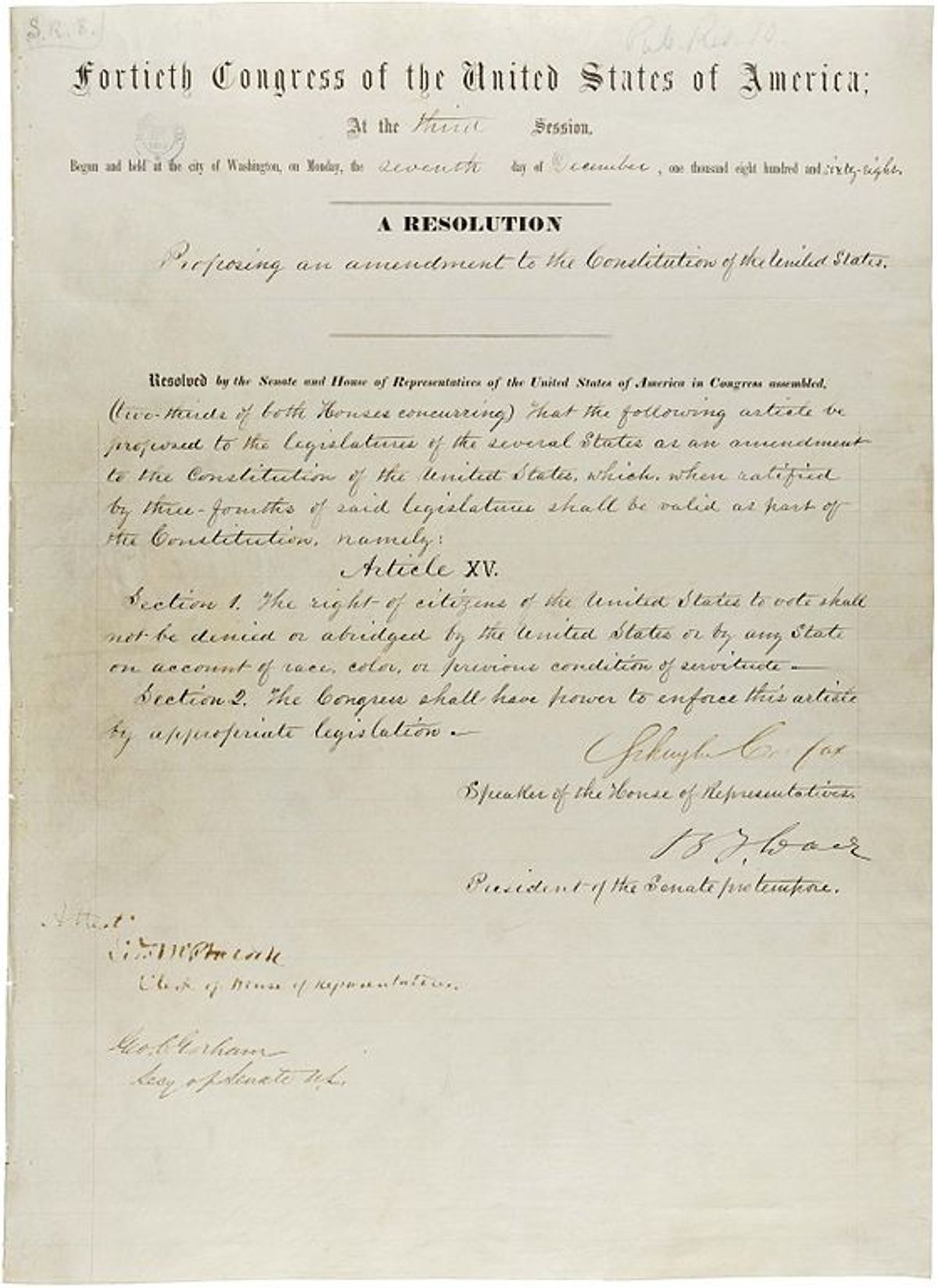
President Grant claimed the 15th Amendment completed “the greatest civil change” in American history, but African American women were not included and would not be extended the franchise until the 19th Amendment was ratified in 1920. Original proposals for the 15th envisioned an America where no voter could be denied access to the ballot on the basis of “race, color, nativity, property, education, or religious beliefs,” but these ran afoul of the desire to keep foreign-born whites and Chinese out of the voting booth, not to mention still disenfranchised ex-Confederates. Text that explicitly banned specific tools of voter suppression--from poll taxes to literacy tests--was also stripped from the final Amendment, thereby opening the door to another hundred years of effective disenfranchisement. Although the Voting Rights Act of 1965 looked to definitely complete the work the 15th Amendment, that work remains arguably unfinished.
When the 15th Amendment passed the 28 state threshold required for ratification and certification on February 3, 1870, California was not among that number. The Democratic-led Golden State had rejected the amendment on January 28, 1870, and would not formally ratify it until 1962. Los Angeles’ black male voters would have to fight to secure their already secured right to vote, as Nathan Masters of Lost LA recounts:
"At four o'clock on the morning of April 12, 1870, dozens of explosions echoed through the dark and empty streets of Los Angeles. The booming noise might have startled the town's horses and roused some of its residents, but this wasn't the sound of violence. It was the sound of freedom. The blasts were coming from the top of Bunker Hill, where some fifty people – almost half the city's African-American population – gathered to watch as anvils were shot into the air over and over again in celebration of the Fifteenth Amendment to the U.S. Constitution. The festivities lasted well into the evening and even the following morning. That night, hundreds of white Angelenos joined the celebrants at a grand Ratification Ball that culminated in a midnight supper.
Just four days later, Lewis G. Green walked into the county courthouse and attempted to exercise the right so many Angelenos had just celebrated by registering to vote. The county clerk refused. The reason? Green was black.”
When Green was finally allowed to register--after Green filed suit and Congress intervened--his name’s addition to the rolls came with a footnote: a “C” for colored, and a notation that he had only been added by the clerk under duress "per Fifteenth Amendment." Today’s conflicts around gerrymandering, voter identification requirements, restoring voting rights to the formerly incarcerated, and the overall enforcement of the Voting Rights Act are can be seen as extensions of Green’s fight, African American access to the polls as contested as it was in 1869.