
learn
600state
An Act to Regulate the Elective Franchise in the Territories of the United States. Section 9: From and after the passage of this act there shall be no denial of the elective franchise in any of the…#blackhistory: On January 10, 1867, Congress passed the Territorial Suffrage Act which allowed African American men in the western territories to vote
share


African Americans vote for the first time, as depicted in 1867 on the cover of Harper's magazine. Engraving by Alfred R. Waud.. Engraving by Alfred R. Waud
An Act to Regulate the Elective Franchise in the Territories of the United States.
Section 9: From and after the passage of this act there shall be no denial of the elective franchise in any of the Territories of the United States, now or hereafter to be organized, to any citizen thereof on account of race, color, or previous condition of servitude; and all acts or part of acts, either of Congress or of the Legislative Assemblies of said Territories, inconsistent with the provisions of this act, are hereby declared null and void.
Approved, January 10, 1867
By April 1865, the American Civil War had come to a close, but the battle for African American civil rights continued to rage. The end to formal hostilities had not curtailed acts of anti-black terrorism in the former Confederacy (South Carolina’s Robert Smalls would put the number of murdered formerly enslaved at 53,000), while plans for post-war Reconstruction bogged down after Abraham Lincoln’s assassination, newly elevated Vice President Andrew Johnson and Congress finding themselves at loggerheads.
How should Confederate states be readmitted to the Union? Should Confederate leaders be tried? Who should manage Reconstruction? Congress, the President, or the South? What rights and reparations should the over four million formerly enslaved receive? Johnson’s answers to these questions could be generously termed forgiving. The Tennessee Democrat had been a staunch Southern Unionist (he’d fled his home state after it seceded and had the distinction of being the only member from a seceded state to remain in the Senate during the war years), but as President quickly pardoned all white Southerners except the highest-level Confederate leaders, allowed the seceded states to form their own post-War governments, returned all confiscated land to pre-War owners and made no effort to secure the voting rights of freedmen and the formerly enslaved in the South.
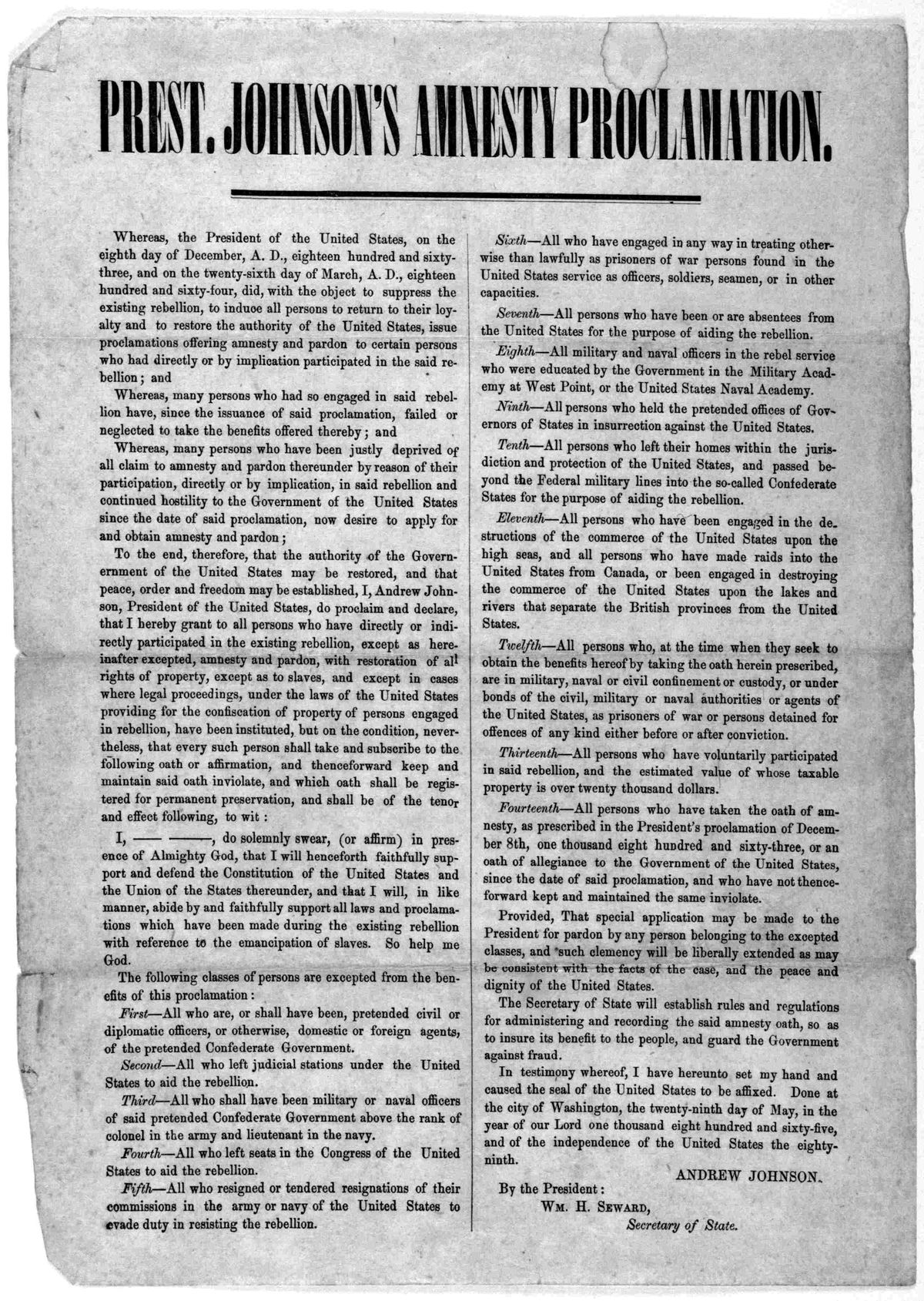
This largesse had immediate results in the South, all of them negative for African Americans. Unrepentant Confederates quickly returned to the leadership of their defeated states, with figures like former CSA Vice President Alexander Stephens being designated to the next Congress. States across the South enacted Black Codes designed to restrict black voting rights and rebind the formerly enslaved to the lowest rung in the South’s agricultural economy.
Congress, led by its Radical Republican members, responded by refusing to seat incoming Southern legislators and claiming for itself the right to set Reconstruction’s terms. This process would hit its stride with the 40th Congress, which met from March 4, 1867, to March 4, 1869 and is often called the Reconstruction Congress, but began in 1866 with the Civil Rights Act of 1866, which provided for “the equality of citizens of the United States in the enjoyment of civil rights and immunities,” and the District of Columbia Sufferage Act, which granted “all adult male citizens of the District of Columbia the right to vote.” Congress followed that up on January 10, 1867, with the Territorial Suffrage Act, which prohibited any restrictions on suffrage based on color in all U.S. territories. All three bills were vetoed by President Johnson and had to be forced into law by Congressional override.
Although the final battle for the Territorial Suffrage Act, which enfranchised about 800 black male voters, was fought in Washington, D.C., the first salvo was launched in the American West by a group of African American activists. In Colorado, three barbers (one of whom, William Jefferson Hardin would later become Wyoming’s first black legislator) decided to test the then-territory’s restrictions on black suffrage. They petitioned the territorial governor and members of Congress for the right to vote, an unlikely effort that bore unexpected fruit.
The 40th Congress would go on to pass the Reconstruction Acts, the Fourteenth Amendment, and what would become the Fifteenth Amendment. It would also impeach Andrew Johnson in 1868, the House approving articles of impeachment only to have the Senate acquit him of charges.