learn
600state
As the Great Depression began to ease in the late 1930s, many - but not all - Americans were able to return to steady work after a lost decade of joblessness and insecurity. Looking at the…#blackhistory: On June 25, 1941, President Franklin D. Roosevelt issued Executive Order 8802, desegregating the defense industry and fueling a Second Great Migration to the American West
share


Martha Bryant and Eulalie Hampden operating a bolt cutting machine, 1943. Photo: Alfred T. Palmer. <a href="https://commons.wikimedia.org/wiki/File:Alfred_T._Palmer_bolt_cutting.jpg">Library of Congress</a>
As the Great Depression began to ease in the late 1930s, many - but not all - Americans were able to return to steady work after a lost decade of joblessness and insecurity. Looking at the possibility of war across the Atlantic and the Pacific both, President Franklin D. Roosevelt had initiated a massive military buildup, but the resulting boom was typically slow to reach black households. On one side of the job market, black workers were excluded from the training and apprenticeship programs need to access the best jobs, while at the other end African Americans with skills and experience were either barred from managerial positions or forbidden from managing whites. Major shipbuilding and manufacturing unions did not accept black men and women as full members, and the new towns springing up around industrial centers were as segregated and inaccessible as the old.
Frederick Douglass once noted that “[p]ower concedes nothing without a demand,” and this was true about black access to millions of new defense industry jobs.
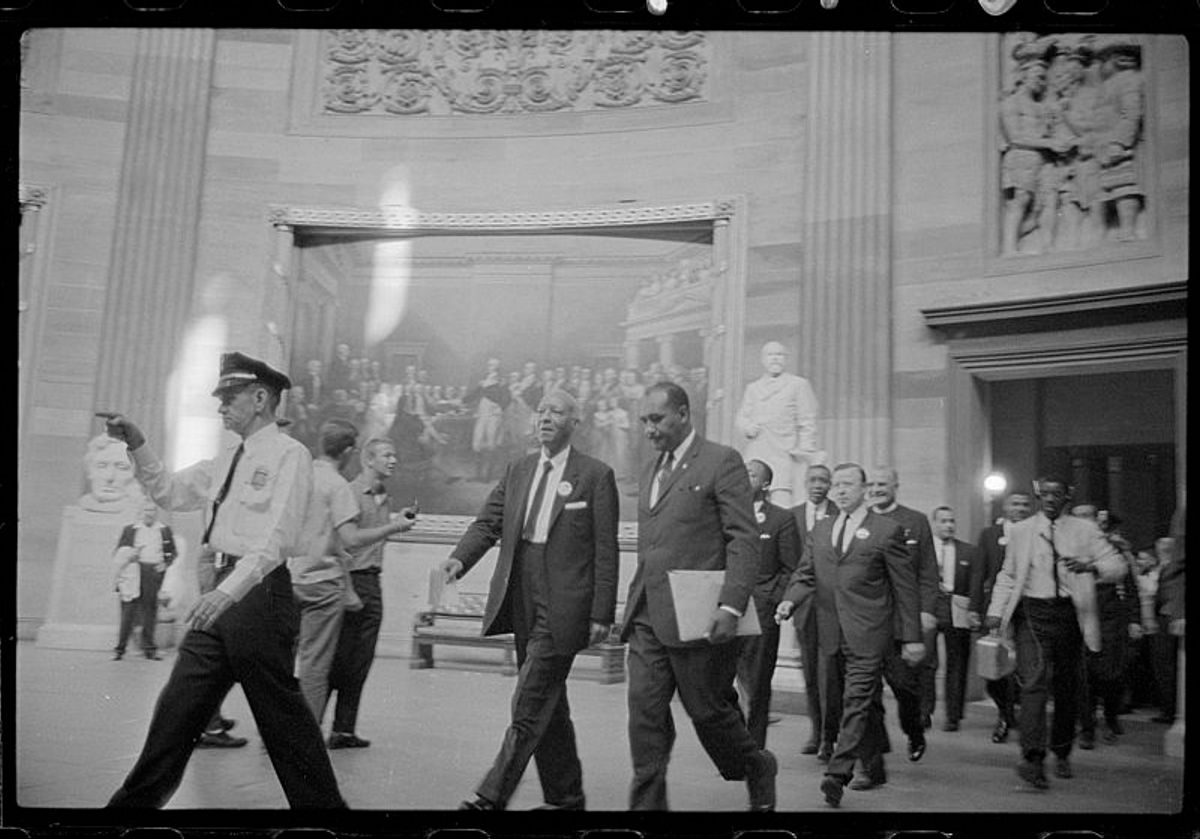
As depression gave way to world war, A. Philip Randolph, head of the Brotherhood of Sleeping Car Porters, and the NAACP launched a campaign calling for an end to employment discrimination in the defense industries. Although weapon and munitions makers needed every worker they could get, Roosevelt and the Federal government had no appetite for pursuing domestic social change in the middle of mobilization for foreign war. Powerful southern Democrats in Congress worked against any effort that might aid African Americans, while the predominantly white unions were predominantly interested in maximizing white employment.
Unable to convince Roosevelt using moral suasion, Randolph and the NAACP decided a more direct force needed to be applied. Randolph announced plans for a 1941 March on Washington that would bring together multiple national civil rights groups and upwards of 100,000 Black working men and women to demand fair and equal employment.
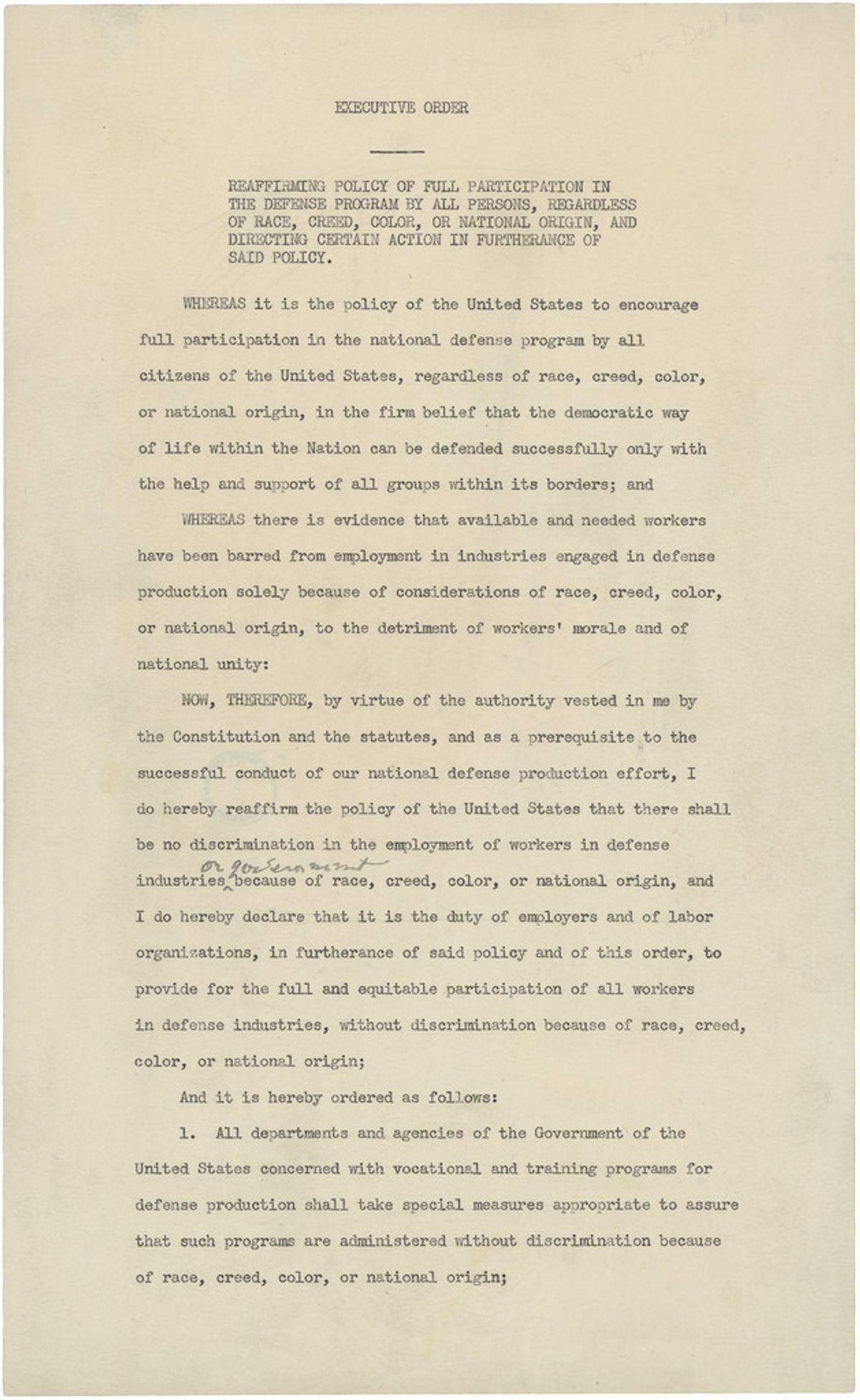
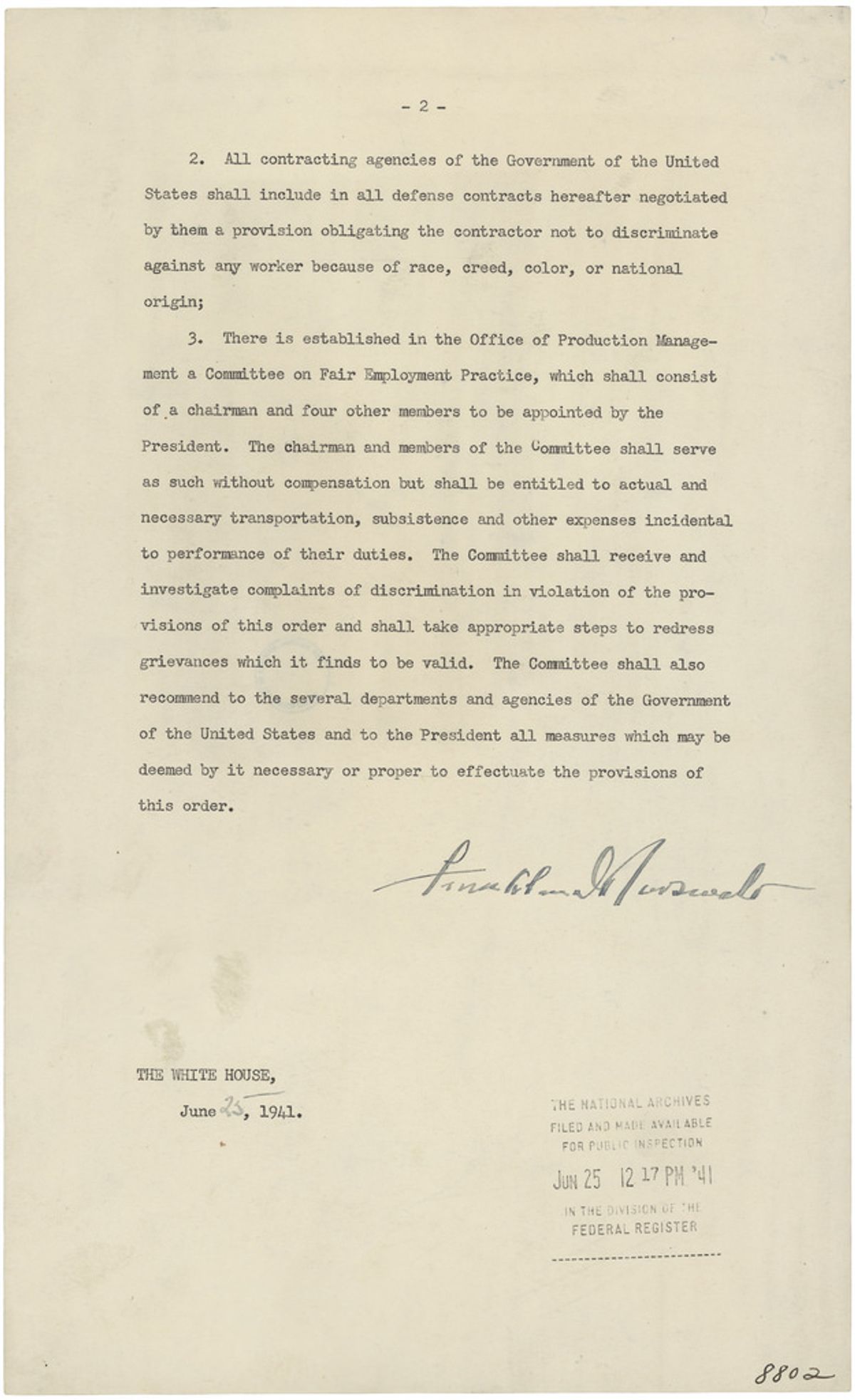
Concerned about the optics of a mass march on the nation's capital during a time of purported national unity, Roosevelt signed Executive Order 8802 on June 25, 1941, one of 3,728 he would sign during his four terms. It read in part:
"WHEREAS it is the policy of the United States to encourage full participation in the national defense program by all citizens of the United States, regardless of race, creed, color, or national origin, in the firm belief that the democratic way of life within the Nation can be defended successfully only with the help and support of all groups within its borders;
and
WHEREAS there is evidence that available and needed workers have been barred from employment in industries engaged in defense production solely because of considerations of race, creed, color, or national origin, to the detriment of workers' morale and of national unity:
NOW, THEREFORE, by virtue of the authority vested in me by the Constitution and the statutes, and as a prerequisite to the successful conduct of our national defense production effort, I do hereby reaffirm the policy of the United States that there shall be no discrimination in the employment of workers in defense industries or government because of race, creed, color, or national origin, and I do hereby declare that it is the duty of employers and of labor organizations, in furtherance of said policy and of this order, to provide for the full and equitable participation of all workers in defense industries, without discrimination because of race, creed, color, or national origin..."
The order instructed government agencies involved in vocational training to "take special measures appropriate to assure that such programs are administered without discrimination because of race, creed, color, or national origin." It similarly required that government contracts include “a provision obligating the contractor not to discriminate against any worker because of race, creed, color, or national origin.” It also established the Fair Employment Practice Committee, which was charged with taking "appropriate steps to redress grievances which it finds to be valid.”
The order was enough to end plans for the 1941 march but left some of Randolph's original objectives unmet. It was the first Federal action ever on employment opportunity, but it did not desegregate the military. (That barrier would wait seven years to fall, in the form of President Harry S. Truman’s Executive Order 9981.) The impact of the order was almost immediate, though, particularly in California. Beginning in 1942, over 340,000 African Americans surged into defense and aeronautics dense towns up and down the Golden State.
While job prospects in Southern California were indeed better, the new arrivals found they faced many of the same obstacles as before. Some plants simply ignored the order, while the nation’s most powerful shipbuilding union, the Boilermakers, persisted in refusing black members. In Los Angeles, Reverend Clayton Russell of the People's Independent Church of Christ in South Central and Charlotta Bass, publisher of the California Eagle, assembled a local version of Randolph’s national coalition in response. Called the Los Angeles Negro Victory Committee, the group engaged in a broad-based fight for employment equality across Southern California. This included working for defense-focused vocational education in Watts, opening up city and county jobs to Black residents, fighting for black conductors on the Los Angeles Railway and working to ensure Black women had access to work besides cleaning and cooking.
These efforts would transform California and its black communities alike, not only creating needed jobs but raising expectations about what fair and equal employment could look like. Those expectations would outlive the war boom and reverberate through the 1960s, from the 1963 March on Washington to the collapse of America’s post-war industrial base. They continue to reverberate today.